Photo by Hekate Boss
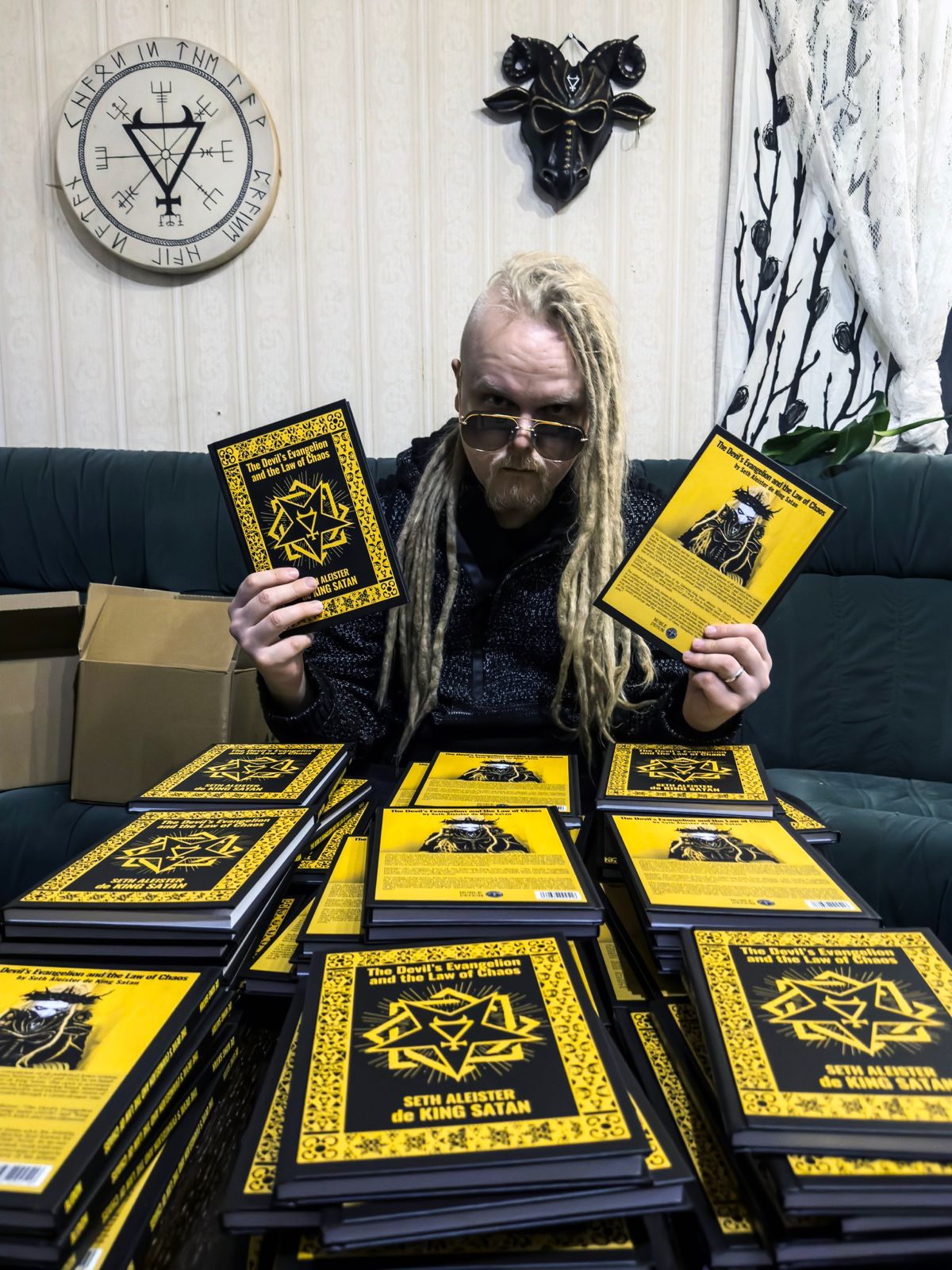
We do love a good extensive King Satan interview here at Soundscape, so with the release of King Satan’s latest opus The Devil’s Evangelion along with an accompanying lyric book – it was clearly time for interview round three! This time we spoke about all things lyrical with King Aleister Satan. So get yourself comfy and stick on the new album to listen to whilst sinking your teeth into this opus, and get ready to learn about all things lyrically related to King Satan, Saturnian Mist and more!
So you recently released a book detailing lyrics from the four King Satan albums, as well as featuring choice cuts from some of your releases with Saturnian Mist (and quotes from interviews regarding both bands over the years). What prompted the decision to do this now?
Oh, where to start? I suppose the timing was finally on my side. The parent label, UCM.One (of Noble Demon Records), which released The Devil’s Evangelion album, also has a book publishing branch called UCP.One, and they encouraged me to release something extra to accompany the music itself. We thought it would be nice to have a proper lyric book for people who no longer buy physical albums but still want to read the lyrics while listening on digital streaming platforms with lots of extra material. Wrapped in a nice physical package of course.
There must be more to it than that, though?
But of course, there’s more to it! The Devil’s Evangelion album itself was something of a thematic and lyrical summary of the ideas I’ve been working on since the Saturnian Mist days up until now. All of my artistic work has had a strong connection to philosophical and psychological themes surrounding the archetype of Satan, occultism, mysticism, and so on – dating all the way back to the early Saturnian Mist material. With The Devil’s Evangelion album, the circle somewhat encloses, which I explain in the book, so I thought the timing and the purpose aligned very well to gather my lyrics and my ‘best of interview’ answers between hard covers.
I remember you had mentioned this book idea before already – is this the same book? And if not, what happened to the previous idea?
Yes and no. Over the years, I’ve often been encouraged to write a book about my thoughts, and at one point, I even had publishers lined up for that. I started working on some manuscripts, but eventually scrapped them because I found them too boring to read – even for myself, and I actually enjoy complex texts, haha.
Back then, I was trying too hard to sound like someone else instead of embracing my own voice. It’s no surprise that I’m an artist first and foremost, and I like to communicate in my own style more suitable for my persona and temperament. So, instead, I decided to write lyrics and poetry, make music and videos, and talk openly about these ideas in interviews and behind the scenes.
Over time, it became apparent to more and more people following my work that my lyrics and interviews were connected – that they formed a kind of continuum, almost like a book on their own. So, when this lyric book opportunity became reality, I wanted to include some of the best interview excerpts as bonus material. Basically to deepen the lyrical experience and provide insight into the philosophy behind all of my work within a broader context, which I wanted to do already when I was younger, but still searching for my own style.
This same idea for a lyrical book + interview book came into existence again around 2015 by one journalist, who expressed his interest to produce this, but apparently I was too much for him to work with (his words, haha) so it didn’t become reality. I’ve said before in interviews that, thematically, Saturnian Mist and King Satan represent two sides of the same coin – a lyrical and conceptual continuum. So, it was a no-brainer that Saturnian Mist-related material had to be included as well. I think the book’s foreword and first chapter explains this much more than this answer, so I don’t want to repeat myself here on that occasion too much.
On the subject of both bands, did you do anything differently when writing lyrics for SM compared to KS? For me they feel like they’re in the same ‘family’ whilst still being distinct, which I find very interesting.
They are very much so indeed. In so many ways Saturnian Mist is a ‘proto’ King Satan when it comes to the themes. I don’t really have one strict method for writing lyrics for either King Satan or Saturnian Mist, or anything really.
As for my process, it is very intuitive and changes depending on the moment. Sometimes I write a lot of notes, short thoughts, or even aphorisms in a journal and my diary, and later I’ll develop lyrics out of those. Other times, I go into full improvisation mode and record ideas on the spot, almost like I’m letting my subconscious speak before my conscious mind gets involved.
What I’ve realized over the years is that even those ‘random’ improvisations aren’t really random anymore. When you have been developing your own worldview, experience of own reality and artistic identity for years, it shapes everything you do like a mind of its own – even when it feels spontaneous. It’s a bit like learning a language. At first, you need grammar and structure, but after years of speaking, you don’t think about the rules – you just express yourself naturally. Or like martial arts: you train techniques over and over so that in the moment, your movements flow instinctively without thinking. That’s what lyric writing feels like to me now. So for me, it’s this balance of planning and intuition, where both structured notes and pure spontaneity serve the bigger vision, my true will already knows before myself, and I’m eager to find out with my artistic method.
Photo by Joonas Juntunen
The first three King Satan albums are a trilogy – when it came to writing lyrics for the latest album The Devil’s Evangelion, how did this differ?
The Devil’s Evangelion actually has a really long history. Originally, it was supposed to be the debut album for Saturnian Mist, but back then, I didn’t feel ready for it. So instead, Gnostikoi Ha-Shaitan became the first Saturnian Mist album in 2011. Later, I thought maybe it would become the second Saturnian Mist album, but I still didn’t feel ready, so Chaos Magick came out in 2015.
Around that time, I felt the need to make music beyond just black metal, and that’s when I founded King Satan. I thought then, ‘Okay, maybe now I can finally make The Devil’s Evangelion as King Satan’s debut,’ but again, I didn’t feel ready for it yet. So we released King Fucking Satan instead, which focused on the whole ‘Spiritual Anarchy’ theme – something we discussed in the last interview with you. Even after that album, I wasn’t done with the Spiritual Anarchy concept as it turned out. So instead of moving onto The Devil’s Evangelion right away, we continued exploring those ideas in I Want You To Worship Satan (2019) and Occult Spiritual Anarchy (2022). Looking back now, I realize I needed to go through those steps before I could finally approach The Devil’s Evangelion. At the time, it wasn’t a conscious decision – it just happened that way – but now it all makes sense.
The actual breakthrough came in 2022, while I was on vacation in Mallorca with Hekate, who has always been my muse with all things important. I was sitting on the mountainside of Sierra de Tramontana after the Occult Spiritual Anarchy release shows, looking out at the village of Binissalem, and suddenly it all clicked. I had this Eureka moment where I knew exactly how the album had to be done – how the lyrics and music should connect. Right there, I started writing the lyrics almost on the spot, using notes and ideas I had been collecting for decades. It felt like automatic writing or channeling. That’s why this album feels so heavily personal and meaningful to me concept-wise.
Honestly, I think it might be my lyrical magnum opus, because everything I wrote before feels like ”research for this”. Part of me feels that everything I do next will be like a post-script to what this album represents when it comes to the lyrics. That’s also why I’m really happy the lyric book was released. The foreword, bonus material, and lyrics together explain things even better than I can in an interview.
I also think most people don’t yet see how this album and the book fit into the bigger picture of my works – and that’s okay. Even all people close to me don’t fully see it yet. It took me years too to understand myself this way. When King Satan turned 10 this year, I noticed that our older works are finally starting to connect with people the way I intended – even to quite surprisingly to many people who hated them before. I used to joke before that I was ‘faster than the world but the world will come around,’ but now it seems quite that some of these ideas just take time to be understood. The response to The Devil’s Evangelion so far has been incredible – our best yet, with more chart success than ever – which I’m beyond grateful for. But based on how the earlier works open to the public, I’m sure this will not be different. So let’s talk again in 10 years and see if I was just being dramatic or not. Either way, I’ll buy you a drink, haha.
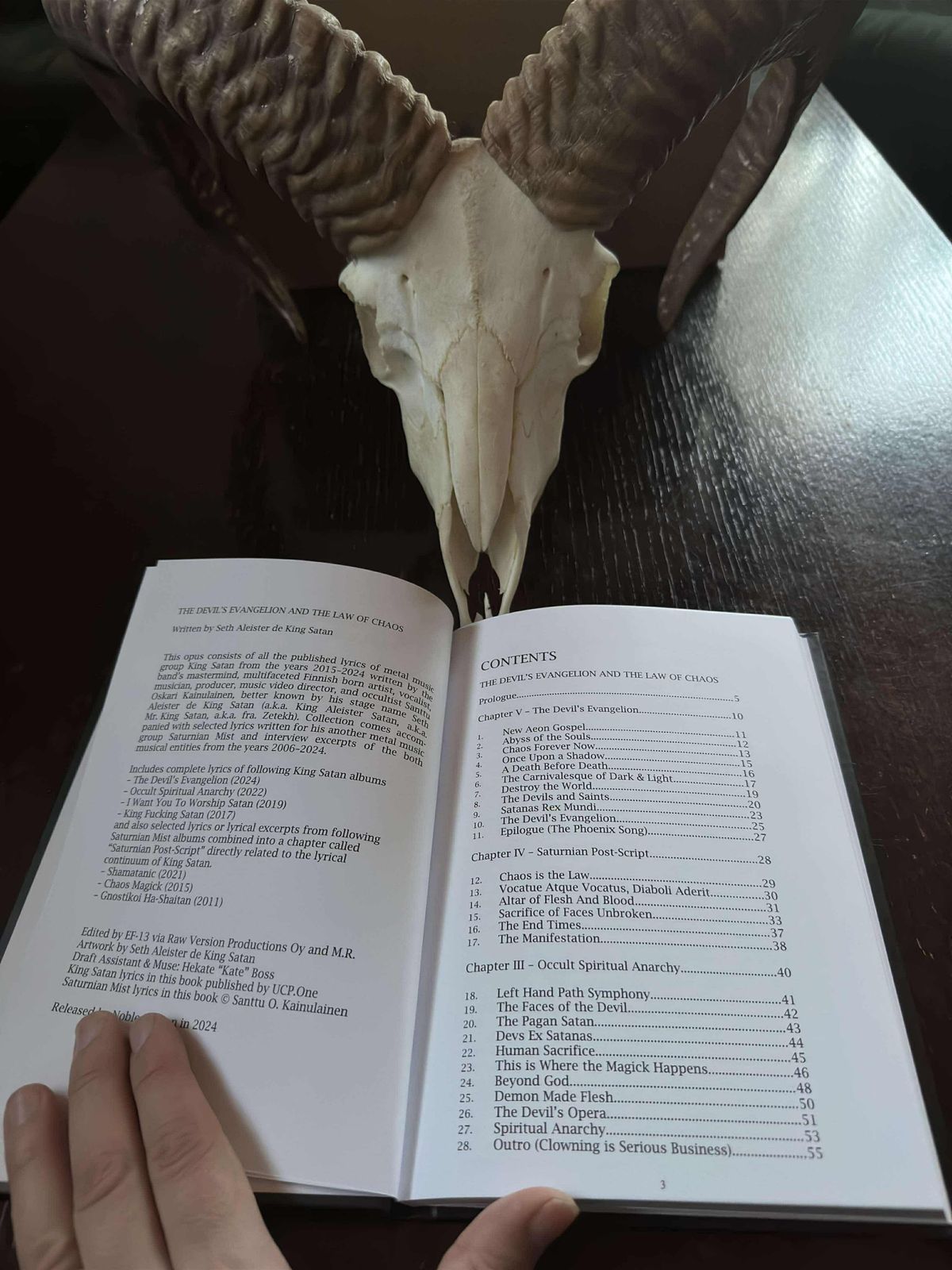 In the book, all of the songs are billed as having a title, and a subtitle. Where did this choice come from?
As mentioned earlier, I write lots of notes from where sometimes the lyrics come from. These title-subtitles are comprised out from them to reveal larger context, but in an artistic and carnivalesque way instead. I also wanted to make the lyrical book more ‘book-like’, not just an every-day lyrical book or booklet – basically like some kind of mixture of the Bible, Bhagavad Gita and Wittgenstein’s Tractates Logico-Philosophicus. So this is why I wanted to do it, and why all the verses are numbered as well with the lyrics.
Two of your songs from the debut – Destroy The World and Spiritual Anarchy – were rerecorded and featured on following releases. Whilst we went into the details of Spiritual Anarchy in our last interview, where you mentioned it fit well into the thematics of the final album of the ‘trilogy’, I’m particularly intrigued about Destroy The World featuring on album four – as it is separate from the trilogy. What prompted the decision to include it on your latest release?
When I first started developing the concept for The Devil’s Evangelion back in 2007–2008 (which was way before King Satan’s existence), the very first song I composed and wrote for it was Destroy the World. That song already contained many key elements of the concept in a microcosm – the idea of duality merging into one through paradoxes, with the archetype of the Devil acting as both the messenger and the director of this process. The original version was actually a neofolk song with minimalistic tribal drumming, but the riffs, melodies and lyrics were the same.
Now if you’re familiar with Saturnian Mist’s work, you can probably understand why this song didn’t feel like it belonged on Saturnian Mist’s debut album. Eventually, we recorded it with Hekate for King Satan’s debut album in 2016, and we performed it live during the band’s early years. However, the album version was heavily electronic, and when Pete Hellraiser joined the band on drums in 2019, we realized that this electro-based version didn’t really fit our live sound any more. So, we created a new live arrangement of the track – but that version ended up being so different from the original album version that we stopped playing it live for years. We even considered releasing this new version on Occult Spiritual Anarchy in 2022, but something told me not to do it. Then, while in Mallorca, I finally understood why. Destroy the World was the first step in the Devil’s Evangelion concept, so it was only natural that the re-arranged version should appear on this album – to close the circle, so to speak.
One of the things I think is great about King Satan is that although the music is fucking brilliant, the lyrics add another layer due to their complexity and the way they make you think. How long does it take you to come up with lyrics?
I’m really honored to hear you think so. It varies, and it’s not easy to explain, because all my lyrics – as I’ve mentioned before – are part of the same continuum. The process is always brewing in my subconscious. For example, the lyrics for The Devil’s Evangelion were written in just two weeks, but they were based on over a decade of notes and ideas.
The lyrics for Occult Spiritual Anarchy were mostly written alongside the composing process over a few months, but again, they drew heavily from notes I had written years earlier. There was also a lot of improvisation involved, like writing while recording. For instance, tracks such as Beyond God, The Devil’s Opera and Outro (Clowning is Serious Business) came together in just a couple of hours. Still, even those songs were manifestations of a larger context that had been forming for a long time.
If we go back to the debut album, Psygnosis was largely improvised while I was recording it, but it was based on a screenplay I wrote during my audiovisual school – a project I never finished because I graduated before completing it. I remembered the core idea of that screenplay and turned it into lyrics on the spot while recording. Meanwhile, other songs like The Faces of the Devil, This is Where the Magick Happens and Fuck Yoga were developed through longer writing process.
Your lyric ”Fuck the rest, Satan is best” is absolutely iconic. Where did you conjure that up from?
Heh, that one was also improvised while I was recording Psygnosis back in 2015. I actually didn’t even intend to be part of the song’s lyrics originally. The part where it is, was supposed to be empty and after the lyrics ended I just spoke the lines there just to amuse myself with a distorted voice and to say the first thing which came to my mind to the rhythm playing in my headphones. When I listened the recording, I laughed out loud and I just had to leave it there because it clicked on so many levels – being over-the-top kitschy, trickster-like and provocative, but still delivering the fundamental idea what I’m dead serious about in a tongue-in-cheek and carnivalesque manner. And it did stick.
I also enjoy that it has appeared in multiple songs of yours, so what is it that makes it so perfect to apply to numerous situations?
I followed the same instinct with this like in the debut album. The song will itself reveal if this line will be recorded. It was nice to have it shouted by a guest artist this time for the The Devil’s Evangelion as my friend Chris from Eggvn recorded guest vocals on this album.
So far I have managed to say it on every album, and would like to flood it across social media as well – but these days social media has tightened their rules and community standards. So saying this slogan out there repeatedly like during our first years, will get our posts restricted and sometimes even deleted which simultaneously sucks – but is also quite awesome, because Satan literally means adversity or adversary, and it is not supposed to be accepted by the status quo, never.
It’s wild how the line has taken on a life of its own amongst fans. When did you first realise fans had really embraced it?
Heh, yeah. I didn’t expect it to become such a thing after that at all, and it still amazes me how it turned out. I think I started realizing its catchiness back in 2017, when my friend told me that he witnessed people wearing King Satan merch crossing each other in the street in Tampere greeting each other first saying ”Fuck the rest…” and the other responding ”Satan is best…” and walking separate ways, even being strangers to each other apparently. But after they spotted the merch of each other this was their greeting style. I found it first hard to believe for a band as marginal as us, but up until I overheard it on few occasions myself right after like in Nummirock and SaariHelvetti festivals I had better believe it.
Photo by Hekate Boss
Chaos is also a topic that is firmly interwoven amongst the lyrics in all of your bands. What is it about chaos that draws you to it?
Chaos and the archetype of Devil are highly entwined concepts. Chaos is the raw and fundamental essence of reality underlying every attempt to understand it. I think my lyrics answer it better than I ever could, and the book as well dives into this in much more holistic manner.
One of my favourite songs lyrically is The Portrait Of Darkness. What can you tell me about that song in particular?
Interesting! It’s one of the most strangest processes when it comest of our songs. We were touring for the first time in Europe in 2018, and our then-guitarist Dalai Daimonicus recorded our merch guy snoring while sleeping on the route, and he sampled it into industrial noise instrumentation, and then I added beats with my drum machine. I think we used it as an outro or intro right after that without lyrics before the second album and its official release.
When it comes to the lyrics, we were already returned from the tour when I recorded them. I woke up in the middle of the night from a very vivid and heavy dream which could be interpreted as a nightmare, but where I had this intense realization feeling like everything would be crystal clear. I kept a dream journal back then, and if I had this kind of experience, I always wrote it down because very often I would forget it otherwise. But this time instead of writing, I remembered that I still had a microphone setup on from the previous evening, and I ran to my home studio and recorded the content of the dream in free flow instead of writing it down. And here you have The Portrait of Darkness.
I enjoy that there’s some songs that are almost light-hearted and jokerish, whilst other songs are a lot darker. Is there one style you prefer to write in, and is there one that’s easier than the other?
At the end of the day, I’m quite a dark, melancholic and cynic person actually, and sometimes it’s just too much to bear with without compensating it with jokerish, tricksterish and optimistic absurdism. Or maybe it is the other way around. Either way, the result is the same, and both are kind of too much to handle alone, which makes writing lyrics occasionally almost pathologically easy, like breathing if I stay true to myself.
Is there anywhere unusual you draw inspiration for writing your lyrics from?
It’s hard to answer to this, because the unusual is usually the source of the best inspiration, but also the reality itself is quite often much stranger than fiction or imagination. ”If you seek a monument, look around”.
Who are your favourite lyricists? Or who has influenced you the most?
Perhaps from the music world I would pick A.W. Yrjänä (CMX), Jim Morrison (The Doors), Maynard James Keenan (Tool), King Diamond, Jon Nödtveidt (Dissection) and Dani Filth (Cradle of Filth) being the most inspirational to me when it comes to the texts alone.
But with rock and metal lyrics the arrangements also means a lot with the context in mind, and with that area lyrics of Deicide, Barathrum, Turbonegro, Tom Waits, Rob Zombie, System of a Down and Slipknot excels and inspires a lot to yours truly. And outside of the rock and metal world it would be not right to leave Eminem unmentioned, because it was his The Marshall Mathers LP which encouraged the 10 year-old me to write lyrics in the first place, even I chose a completely different artistic path after that.
How about completely outside of the music world, then?
I think my biggest influences for lyrics themselves come from outside the music world. As a musician, the structural aspects of my work are often shaped by music world and musicians, but the content, energy, and essence frequently come from elsewhere. There are thought several authors who have written deeply inspirational poetry, aphorisms, and texts too besides their main works, and they’ve influenced me greatly: Dante Alighieri, Aleister Crowley, William Blake, Kahlil Gibran, Charles Baudelaire, Eino Leino, Friedrich Nietzsche, William Shakespeare, and Johannes Nefastos. I had the privilege to work with the latter on Saturnian Mist albums twice, and we even discussed a collaboration with King Satan, though I haven’t yet had the opportunity to include guest writers for this project – but hopefully someday!
Beyond literature – the content, energy, and essence of religious chants, prayers, occult rituals, hymns, folklore, and folk songs have had a major influence on me. Other authors who have shaped my thinking and artistic expression include Mihail Bulgakov, Fyodor Dostoevsky, J.R.R. Tolkien, Anton LaVey, C.G. Jung, Carlos Castaneda, Chuck Palahniuk, Colin Wilson, Hunter S. Thompson, and Jiddu Krishnamurti – at least from the top of my head.
You have spoken many times over the years in interviews about dark comedy and absurdism influencing you as well. Are there any lyricists or authors who have inspired you in that manner?
I love absurdism, black comedy and especially surreal comedy, especially when it is mixed up with serious topics. I think Anton LaVey, Aleister Crowley and Hunter S. Thompson excelled combining some wink into their works when it comes to the authors, also perhaps the overall works of Alejandro Jodorowsky. As a Savonian person this all comes very natural to me, because Savonian people tend to be like that by default. (Although King Satan was founded in Tampere, I was born and raised in Kuopio, in the Savo region in Finland, and I guess I still identify myself as a Savonian first and foremost.). But I think this certain wink of my works is more inspired by movies and tv-series instead of lyrical or book writers. Like early days of The Simpsons, South Park, and Monty Python. Perhaps Bojack Horseman as well. Self-irony, satire and parody has always been close to my heart, but I want to combine it to the serious topics for sure. I think Laibach is the best example of this in the music world, a huge inspiration for me.
There’s many different ways of interpreting lyrics. What do you hope fans take from them?
There truly is, and that’s the beauty of meaningful lyrics and art. Everyone brings their own experiences to a work, entwining them with what they encounter, and that context shapes how a single vision can offer different insights to different people—without any interpretation being more or less valid than another.
Over the years, I’ve been told some remarkably varied interpretations of my lyrics. Some are very close to what I originally intended, some not so much, and some even directly contradict each other. But as I see it, none of them are “wrong” or ”right”. In fact, I find it amazing, because once the lyrics are finished and released, they start to live their own life and I too watch them from the distance forming my own interpretations of ’em. At that point, it’s no longer up to me to be the ultimate judge of how they are understood. I’m not the same person that I was when I wrote them, and the thoughts and experiences of that earlier self shaped the text profoundly.
Of course, I still have a sense of what I was aiming for, so sometimes my guesses are surprisingly on point. But that’s the other thing, I don’t want to make interpretations on behalf of others. To find my own meaning and tie it to my own experiences from the lyrics I enjoy have been one of the best moments with my favourite artists and authors, so I don’t want to take that away from anyone. I speak a lot about the themes and ideas in interviews, but I never want to interpret lyrics at least publicly or sober, heh. If something I’ve written has inspired, moved or made any kind of impact to anyone I have reached beyond of my hopes of what I do.
(I was going to say preferably positive, but I’d be lying then, because I want to provoke and piss off people as well as much as inspire. Sometimes even more).
And finally, even though it’s not strictly lyrically-related, I have to ask because it was one of my favourite comments in the book. You quoted something from one interview that wasn’t released because your answers pissed the interviewer off. What do you think it is about King Satan that causes such controversy sometimes?
Those have been some pretty surreal moments. A couple of times, it happened when the interviewer had a conservative or strongly religious background and suddenly realized mid-interview that this isn’t just a stage persona – I’m genuinely a devout Satanist and occultist outside of the stage as well, and they were dealing with a real person holding these beliefs. I guess it all starts with the band’s name. “Satan” is such a loaded concept – almost everyone familiar with world religions already has a fixed idea of what it represents. That alone creates heavy prejudices and assumptions even before they hear the music.
We embrace that ambiguity in a very trickster-like way, which probably confuses people even further after hearing the music or seeing the videos. We play with high contrasts and paradoxes, mixing serious aspects with black comedy and irony, all while meaning things in a deliberately absurdistic manner. And even in 2025, presenting Satan as not exclusively malicious or evil still sets off a lot of red flags, especially for people with conservative or fundamentalist religious backgrounds.
You can purchase the book, latest album and much much more from here!